


Trust rarely breaks in one dramatic moment. In our experience, it usually weakens in small scenes. A delayed reply. A promise that fades. A meeting where someone feels ignored. Then one day, the tone changes, and everyone feels it.
That is why trust repair needs more than good intent. It needs clear action. It also needs patience, because broken trust affects not only one bond, but the whole network around it. Friends, colleagues, clients, teams, and partners all react to the atmosphere that trust creates.
Fractured trust is not just a relationship problem. It is a pattern problem.
We also need to face the wider setting. Recent findings on the decline of interpersonal trust in the U.S. show how common suspicion has become. When trust is low in society, even small mistakes can feel larger. People expect disappointment faster. They protect themselves sooner.
Still, trust can be rebuilt. Not by force. Not by image. By repeated truth in action.
Start with honest ownership
The first repair step is simple to name and hard to do. We need to own what happened without defending ourselves too early.
Many people rush into explanation. They say what they meant, what pressure they were under, or why the timing was bad. Sometimes that is real. But if we start there, the other person often hears distance, not care.
Own it first.
Honest ownership sounds direct. We were wrong. We broke a commitment. We hid a concern. We acted in a way that weakened safety. That kind of language has weight because it does not run away.
A real apology names the harm before it names the reason.
Listen for the full impact
After trust breaks, people do not only react to facts. They react to meaning. They ask themselves what the event says about their place, value, and safety in the connection.
We have seen this in teams many times. One person thinks the issue was only a missed handoff. The other person felt publicly dismissed. Those are not the same injury.
So we need to listen longer than feels comfortable. Ask what the event changed for them. Ask what became harder after it. Ask what they now hesitate to believe.
A short set of questions can help:
What part of this affected you most?
What did you stop trusting after that happened?
What would help you feel safe again?
This is not a performance. It is a way to let reality come into the room.

Make the damage visible
Trust repair becomes weak when it stays vague. We need to name what was damaged in practical terms.
Maybe the fracture touched reliability. Maybe confidentiality. Maybe fairness. Maybe respect in front of others. When we identify the exact area, repair becomes possible.
Without that clarity, people say they want trust back, but they are trying to fix different things.
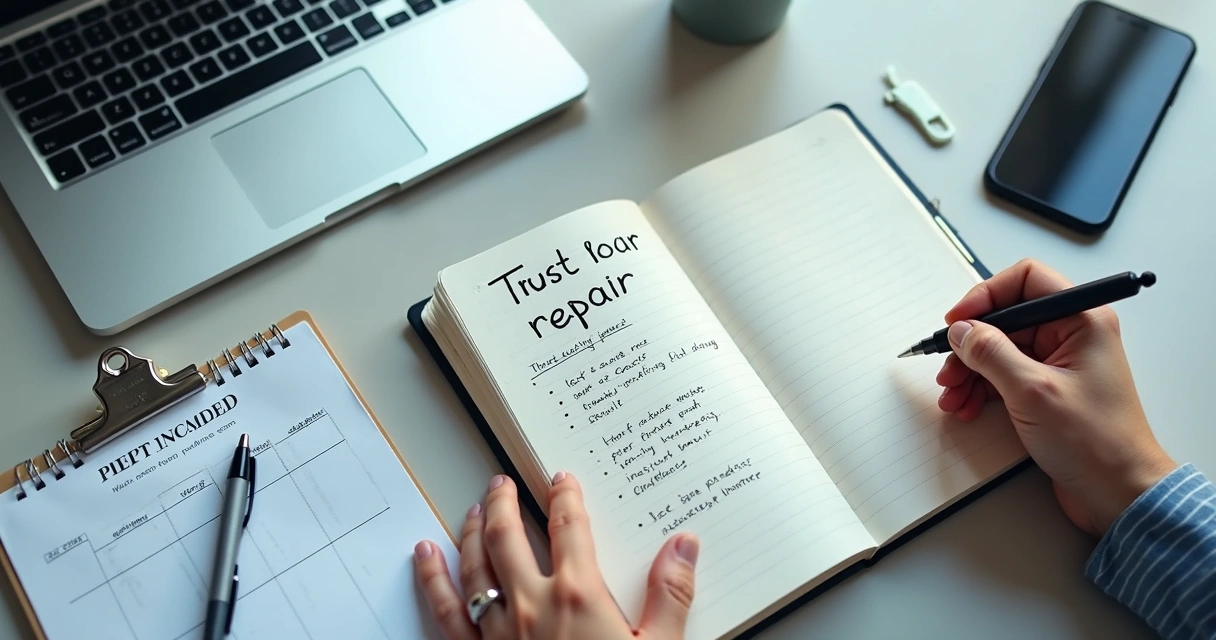
We suggest writing it down in plain words:
What happened
What trust area was damaged
What behavior now needs to change
This may sound formal, but it saves a lot of confusion later.
Set one small promise and keep it
Grand speeches do not repair trust. Kept promises do.
When trust is weak, it helps to begin with one commitment that can be seen and checked. Not ten. One. A weekly update by Friday. A clear response within 24 hours. A written recap after meetings. A direct check-in before making a sensitive decision.
Trust grows back through evidence, not intensity.
Small kept promises calm the nervous system. They show that change is not only being discussed. It is being lived.
We once watched a strained partnership begin to recover through something almost modest. One person had failed often on follow-through. Instead of promising total change, they sent a short progress note every Thursday for six weeks. It was plain. It was consistent. It worked.
Repair in public when the damage was public
Some trust breaks happen in private. Others happen in front of the network. A leader dismisses someone in a meeting. A partner shifts blame in a group message. A friend repeats something personal in a shared circle.
When the injury is public, private regret is not enough.
The repair must meet the size of the rupture. That does not mean drama. It means proportion. If several people saw the damage, several people may need to see the correction.
This can include:
Clarifying the facts in the same group
Restoring credit where it was removed
Taking responsibility without shifting blame
Public repair restores more than one person. It restores the field around the relationship.
Change the conditions, not just the mood
Many trust problems return because the setting that caused them stays untouched. Good feelings after one conversation are not enough if the structure still invites the same mistake.
If deadlines are unclear, define them. If roles overlap, reset them. If confidential topics move through too many channels, narrow the path. If conflict stays hidden until it becomes sharp, create a regular place to address it earlier.
Repair needs emotional honesty, yes. But it also needs design.
We think this is where many people get discouraged. They apologize well, then repeat the same pattern because the context keeps feeding it.
Give people room to be careful
One hard truth matters here. The other person may not trust us right away, even if we do everything right. That does not always mean failure. It may mean they are being honest about their pace.
Trust cannot be demanded.
We should not pressure someone to feel safe before they are ready. We can invite, show, clarify, and stay steady. But if we rush them, we create a second injury.
This applies in professional networks too. A colleague may become more formal for a while. A partner may ask for written confirmation. A client may want more checkpoints. We should read that not as rejection, but as a bridge phase.
Keep your behavior steady over time
In the end, trust repair is less about one moment and more about pattern stability. People start believing us again when our actions stop sending mixed signals.
That means staying respectful when stressed. Following through when no one reminds us. Speaking truth early instead of late. Being the same person in private and in the group.
Consistency is what turns apology into credibility.
Time matters here. Not because time heals by itself, but because time reveals whether change is real. A week can open the door. A few months often show the deeper truth.
Conclusion
Repairing fractured trust in a network is slow work, but it is not mysterious. We rebuild it when we own the damage, hear the impact, define what broke, make small reliable promises, repair publicly when needed, change weak systems, respect caution, and stay consistent long enough for others to feel the difference.
Some bonds will not return to their old form. That is real. Yet many relationships become cleaner and stronger after repair because they are now built with more truth than before.
When trust breaks, people watch closely. When trust heals, they watch that too.
Frequently asked questions
What is fractured trust in a network?
Fractured trust in a network is a breakdown of confidence between people who are connected through work, friendship, partnership, or community. It happens when actions create doubt about honesty, reliability, fairness, or respect. The effect often spreads beyond two people and changes the tone of the wider group.
How to rebuild broken trust effectively?
We rebuild broken trust effectively by taking responsibility, listening to the full impact, naming what was damaged, and proving change through repeated action. Clear promises, steady follow-through, and patience usually work better than emotional speeches or quick fixes.
Why does trust break in professional networks?
Trust often breaks in professional networks because of missed commitments, poor communication, hidden motives, blame shifting, lack of transparency, or public disrespect. In some cases, the issue is not bad intent but weak systems that create confusion and repeated disappointment.
Is it worth it to repair trust?
Yes, many times it is worth repairing trust, especially when the relationship has real value and both sides are willing to do honest work. Repair can restore cooperation, reduce tension, and create a stronger bond. Still, repair makes sense only when behavior truly changes.
How long does trust repair usually take?
Trust repair can take weeks or months, depending on the depth of the harm, the history of the relationship, and the consistency of new behavior. Small breaks may heal faster. Larger betrayals usually need more time because people need repeated proof before they feel safe again.