

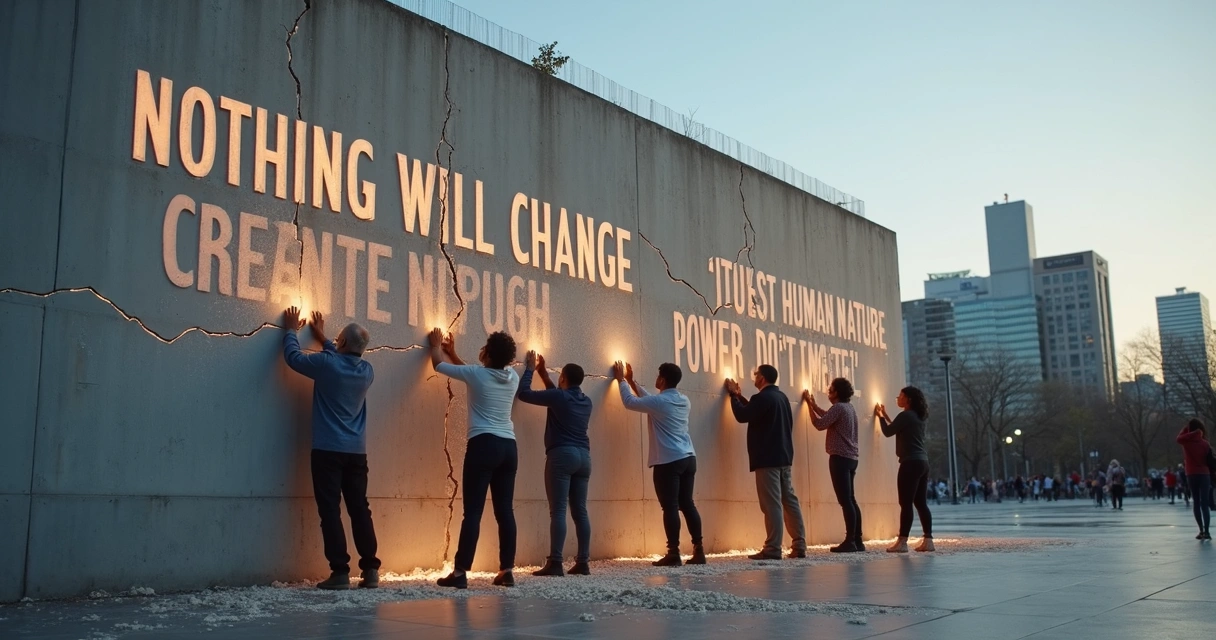
We often speak about social change as if it were only a matter of policy, leadership, or resources. Those things matter. Still, in our experience, collective change slows down much earlier, in the hidden layer of belief. A group can have talent, good intent, and even clear evidence, yet remain stuck because it keeps obeying ideas that no one has fully questioned.
Collective change begins to fail when a community treats fear-based beliefs as facts.
We have seen this in workplaces, families, schools, and public life. People say they want renewal, but then repeat the same inner script: nothing can change, people are selfish, conflict means danger, truth is risky, and someone else will fix it. These beliefs do not only live in individuals. They spread through tone, habits, and shared silence.
When this happens, the outer system becomes a mirror of the inner state. Rules harden. Trust drops. Imagination narrows. Then even small reforms feel threatening.
Belief 1: “People do not really change”
This belief sounds realistic. It often appears after disappointment. We trust, we invest, we wait, and then someone repeats the same behavior. After enough frustration, cynicism can start to feel wise.
But there is a cost. When a group assumes that people cannot mature, it stops building spaces that support growth. It moves from guidance to control. From dialogue to labeling. From patience to punishment.
What we stop believing in, we stop making possible.
We think this belief weakens collective life in at least three ways:
It reduces accountability to blame.
It blocks learning after conflict.
It turns past behavior into a permanent identity.
A community changes when it can hold two truths at once: people must face consequences, and people can still develop. Without that balance, systems become rigid. They may look strong, but inside they are only defending old pain.
Belief 2: “If one group gains, another must lose”
This is one of the most damaging beliefs in public life. It teaches us to see progress as a threat. It trains people to suspect fairness, sharing, and inclusion, as if these always take something away from others.
Zero-sum thinking turns cooperation into suspicion before cooperation even begins.
Research supports this pattern. Work from Loyola University Chicago on zero-sum beliefs and collective action found that people who hold these beliefs are less likely to support actions that challenge unfair systems. That matters because change often asks groups to imagine benefit beyond immediate self-interest.
We can picture a common scene. A team discusses a new policy meant to widen participation. Before the details are even clear, tension enters the room. Someone assumes loss. Another prepares defense. Soon the meeting is no longer about the policy. It is about fear of displacement.
That is how a limiting belief becomes a social force.

Another study from Harvard Kennedy School on zero-sum environments and effort-suppressing beliefs suggests that when environments are structured around zero-sum logic, beliefs that lower effort may spread because they reduce short-term strain. Yet this can weaken long-term growth. We find that idea deeply relevant beyond economics. When people think effort, trust, and shared progress do not pay, they stop bringing their fuller selves to common problems.
Belief 3: “Keeping the peace matters more than telling the truth”
Many groups confuse harmony with health. We understand why. Honest conversations can unsettle relationships. They expose contradictions. They disturb polite routines. For a moment, everything feels less stable.
Still, false peace is expensive.
When truth is delayed for too long, pressure builds under the surface. A team avoids naming a broken process. A family refuses to address resentment. A community sees a pattern of harm but calls it “not the right time.” The silence feels safer, until it becomes the problem.
Peace without truth is only tension that has learned to stay quiet.
We are not defending harsh speech or constant confrontation. The point is simpler. Real peace grows when people can name reality without being treated as a threat. Mature groups learn to stay present in discomfort long enough for a deeper order to emerge.
That kind of honesty changes culture. It tells people that reality can be faced, and that difficult truth does not have to destroy belonging.
Belief 4: “The group is right because the group agrees”
Consensus can be wise. It can also be a trap. There are moments when agreement is not a sign of clarity, but a sign that doubt has become unwelcome.
We have all felt the pressure of that room. Heads nod. The pace is fast. One person hesitates, then stays silent. Another senses a flaw, but does not want to look negative. Soon the group moves ahead with growing confidence and shrinking perception.
This is not harmless. Research from the National Bureau of Economic Research on groupthink and collective reality denial shows how groups can become resistant to evidence, especially when shared belief starts to replace direct contact with facts. In organizations and markets, this can lead to denial, excess, and eventual collapse.
We think the same pattern appears in everyday collective life. Group agreement can become a shield against reflection. To prevent that, communities need habits that protect honest dissent, such as:
Inviting disagreement before decisions are closed.
Rewarding questions, not only confidence.
Reviewing failed assumptions without humiliation.
When a group cannot question itself, it slowly loses contact with reality.

Belief 5: “Change is someone else’s job”
This belief is quiet, but very common. It appears in phrases like: leadership should handle it, the next generation will solve it, institutions need to act first, people with more power must begin.
Part of this is true. Some people do hold more influence. Some decisions do require formal authority. But collective change weakens when responsibility is always pushed upward or outward.
We have seen small shifts create new conditions. One person names a pattern no one wanted to name. A manager admits an error without self-defense. A parent changes the emotional tone of a home. A local group chooses listening over accusation. These acts may look small. Yet they alter the field around them. Others begin to respond from a different place.
Shared change grows when responsibility becomes personal before it becomes political.
This does not mean blaming individuals for large structural problems. It means seeing that every structure is fed by repeated human choices. Systems stay alive because habits stay alive.
Conclusion
The deepest barriers to collective change are not always visible. They often live in the beliefs a group has normalized for years. If people cannot change, if another person’s gain is our loss, if truth is too disruptive, if agreement proves wisdom, and if responsibility belongs elsewhere, then even the best plans will lose force.
We believe a healthier future asks for inner maturity as much as external reform. When beliefs become more honest, more generous, and more grounded in reality, new forms of action become possible. Culture shifts. Institutions respond. Relationships regain depth.
Change outside follows change inside.
If we want lasting collective transformation, we must question the beliefs that keep repeating the old world inside the new language.
Frequently asked questions
What are limiting beliefs in society?
Limiting beliefs in society are shared assumptions that narrow what people think is possible, fair, or worth trying. They often sound normal, but they can block trust, learning, and action across groups.
How do limiting beliefs affect change?
They affect change by shaping behavior before decisions are even made. If a group believes change will fail, create loss, or bring conflict, people may resist new ideas, avoid hard conversations, and protect old systems.
What are examples of limiting beliefs?
Examples include believing that people never change, that one group can only gain if another loses, that silence keeps peace, that majority agreement means truth, and that fixing social problems is always someone else’s job.
How can we overcome limiting beliefs?
We can overcome them by noticing repeated assumptions, testing them against reality, making room for honest dialogue, and practicing responsibility in daily choices. Change starts when people stop treating inherited beliefs as final truth.
Why do limiting beliefs persist collectively?
They persist because they offer emotional comfort, social belonging, and a sense of order, even when they cause harm. Groups often keep familiar beliefs because questioning them can bring uncertainty, conflict, or the need for self-examination.